
Costs
Remote Marketing Jobs: Salary and State Tax Facts in the US
Remote marketing jobs salary depends on your state, and so does the tax bill. Here is who has jurisdiction, what must be disclosed, and what happens if you skip it.
What to take away
- Two states can tax one paycheckwhere you live and where you work.
- New York and a few other states tax remote days worked out of state when the employer's office is in state.
- Form W-2 boxes 15 through 17 name the state that withheld and the wages it counted.
- Federal rules require payroll records for three years and supporting time records for two.
- A missed nonresident return usually ends in a notice, back tax and interest.
Who has jurisdiction over a remote marketing job
A remote marketing job creates more than one tax claim. The state where you live can tax your income as a resident. The state where you physically work can tax the wages earned inside its borders. The state where the employer's office sits may withhold as well, and that claim survives even when you never set foot there.
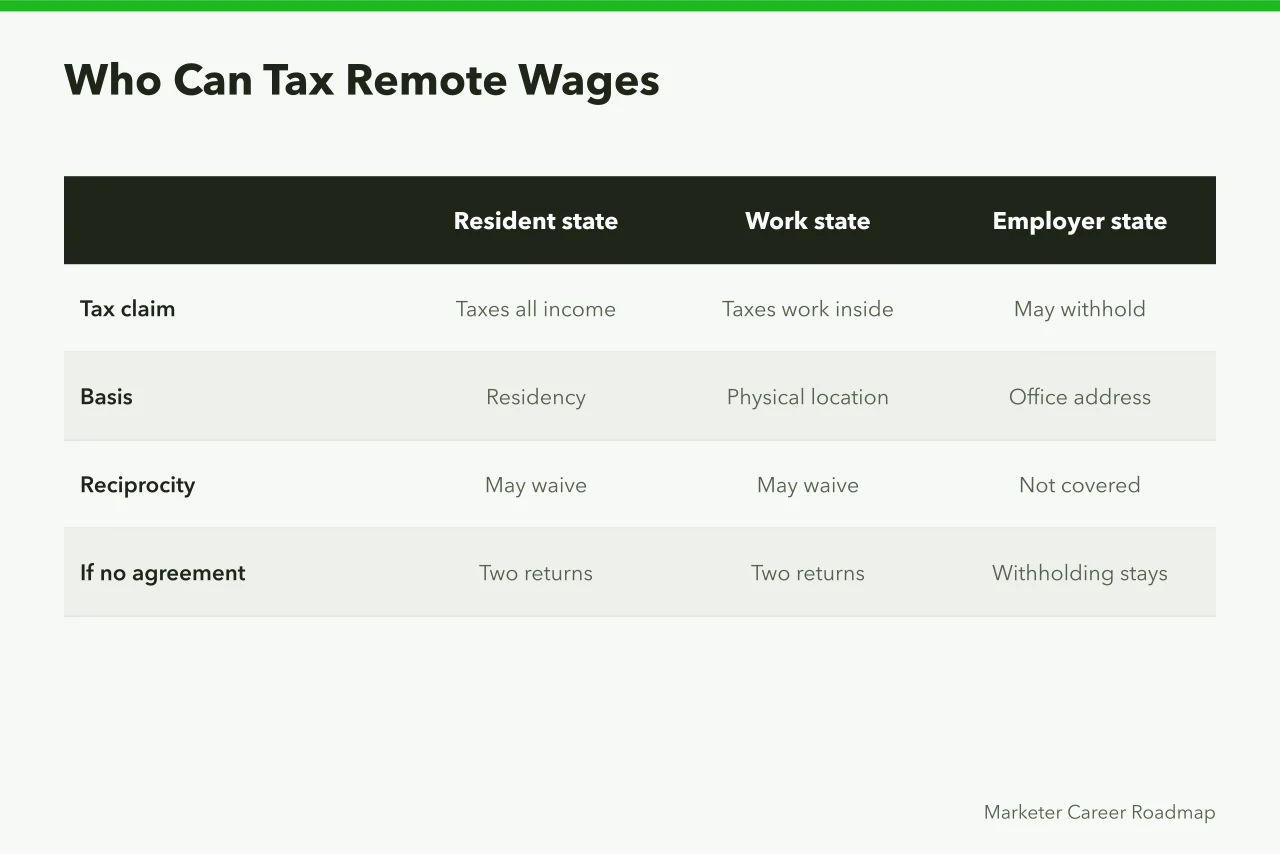
Residency and withholding rules for people who move between states sit in IRS guidance on withholding. Some bordering states hold reciprocity agreements, so a resident of one can work in the other without filing twice. Where no agreement exists, the same wages can produce two returns.
Duties inside the role do not move the map. The split between digital marketing roles rarely decides which state claims the wages. The payroll address does.
What a compliant remote work disclosure contains
A compliant notice names the designated work location and the tax home used for payroll. It states which state's wage and hour law governs the job, and whether the role is exempt from overtime under the FLSA. It sets out who buys the equipment and how expenses get reimbursed.
Where a state pay transparency law applies, the posting or offer must carry a salary range and a benefits summary. Colorado, California, New York, Washington and Illinois are among the states that require it. Salary disclosure is the part employers most often get wrong.
Remote salary figures and the state that reports them
Wage data is published by employer location, not by where the laptop sits. Estimates for marketing managers show medians that differ by state and industry. A remote offer built on a national average can sit above or below the local market.
The Bureau of Labor Statistics shows how wide that state effect is. Its Occupational Employment and Wage Statistics for marketing managers in May 2022 put the national median annual wage at $140,040, and the top paying states by annual mean wage were New York at $190,230, California at $186,550 and New Jersey at $184,820. Those are manager-level, employer-location figures; specialist and analyst roles sit in other occupations with their own tables, and later releases update the numbers.
The newer national medians show the spread across marketing roles. The Occupational Outlook Handbook puts the median annual wage for advertising, promotions and marketing managers at $166,790 for marketing managers and $133,660 for advertising and promotions managers in May 2025. On the analyst side, the median annual wage for market research analysts was $78,760 in May 2025. A remote posting for an analyst and one for a manager therefore start from bands roughly twice apart before the state question arises.
Read posted remote ranges against those medians and against the employer's location, not against a national average alone, and check whether the range is base pay or total pay.
Records to keep
- A monthly log of days worked in each state, with the address used.
- Copies of Form W-2, especially boxes 15 through 17, and every state withholding statement.
- The employer's written remote work policy and any equipment agreement.
- Reimbursement receipts and home office records for any deduction you claim.
Employers carry a parallel duty. Federal rules at 29 CFR 516.5 and 516.6 require payroll records to be kept for three years, with supporting time records held for two. People in freelance marketing careers keep the same file without an employer holding a copy.
What happens if you do not comply
A state revenue department learns about a missing return from employer withholding records or a federal data match. It issues a notice and assesses the tax it says you owed, plus interest and a penalty. New York can hold the employer liable for tax that should have been withheld from a nonresident employee who worked from home.
Withholding is not the bill. It is a deposit against a bill nobody has calculated yet.
Misclassification is the other trap. The US Department of Labor can recover back wages plus an equal amount in liquidated damages when a remote worker is wrongly treated as a contractor.
Where the rules differ by place
Wage tax
- New York
- Yes
- Florida, Nevada, Tennessee, Texas, Washington
- No
- New Hampshire
- Interest and dividends only
Point to watch
- New York
- Convenience of the employer test can tax out-of-state days
- Florida, Nevada, Tennessee, Texas, Washington
- No return on wages, but nexus and residency still count
- New Hampshire
- Wages untaxed, so a credit is usually wasted
Agencies cross state lines constantly. An employer that hires SEO careers staff across several states picks up withholding duties in each place a worker sits, once nexus thresholds are met. The shift toward telecommuting has outrun the guidance that explains it.
Example: a New Hampshire resident on a New York payroll
A marketer lives in New Hampshire and works from home for a Manhattan agency. New York's convenience test treats those home days as New York work because the employer's office is in the state.
She files a New York nonresident return on Form IT-203, the Nonresident and Part-Year Resident Income Tax Return, and New Hampshire does not tax wages, so there is no credit to claim. Moving her assigned office to New Hampshire changes the result.