
Industry
Ontario and Quebec marketing job markets compared for bilingual roles
The Ontario Quebec marketing job market differs on ad volume, salary ranges and French-English requirements, so compare Job Bank data before you choose.
What to take away
- The Ontario Quebec marketing job market splits along language lines: Ontario posts more roles overall, Quebec posts fewer but expects French in most of them.
- Job Bank and the Statistics Canada Labour Force Survey are the two public sources worth checking before you move or enrol in a programme.
- Salary ranges for comparable marketing roles run higher in Ontario on paper, but Montreal rents and Quebec taxes narrow the gap.
- French-English requirements are screened early in Quebec, often at the application stage, and rarely in Ontario outside federal and Ottawa-area employers.
- Bilingualism pays in Ottawa and Gatineau, where federal departments and agencies hire communications and marketing staff.
- Study where you intend to workQuebec employers want Quebec credentials and French, Ontario employers mostly want portfolios.
Ontario marketing is in-house, Quebec marketing is agency and French-first
Ontario and Quebec are the two largest provincial marketing markets in Canada, but they are built differently. Ontario carries a bigger share of national advertising, tech and retail head offices. Quebec carries a denser concentration of agencies, media companies and cultural organizations in Montreal.
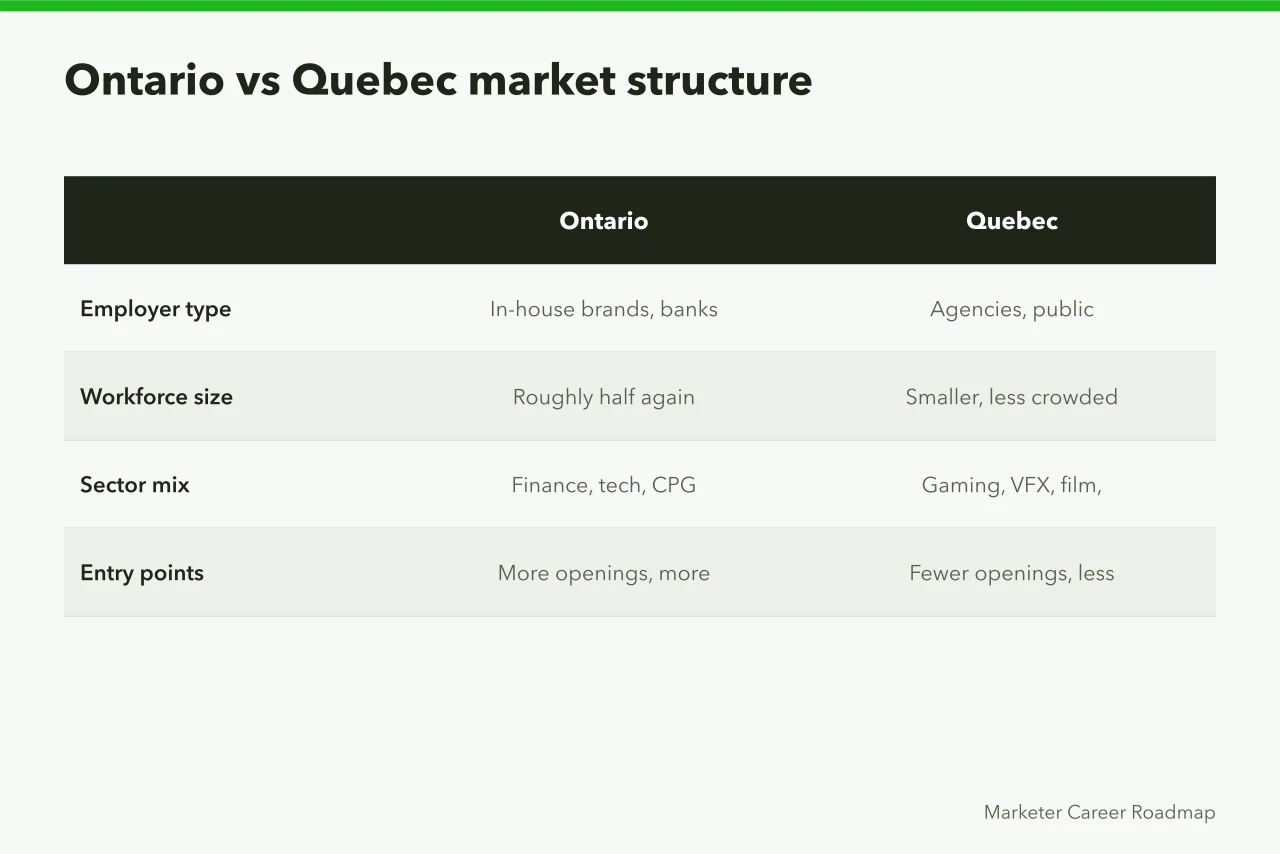
That structural difference shapes what you apply for. Ontario postings skew toward in-house teams at brands, banks, insurers and software firms. Quebec postings skew toward agency roles serving clients in both languages, plus a strong public-sector and cultural-sector segment.
Size matters too. Ontario's workforce is roughly half again the size of Quebec's, so the raw count of marketing openings is larger. Per capita, the two provinces are closer than the headline numbers suggest, especially in Montreal versus the Greater Toronto Area.
The sector mix also differs. Ontario has more financial services, technology and consumer packaged goods marketing. Quebec has more gaming, visual effects, film, fashion and design-adjacent marketing, much of it supported by provincial cultural funding bodies.
For a new marketer, that means Ontario offers more entry points and more competition for each one. Quebec offers fewer openings but less crowding at the junior level, provided your French is genuinely working-level.
Job Bank and Labour Force Survey evidence on demand
Job Bank is the federal government's public labour market tool, run by Employment and Social Development Canada. It publishes job postings, wage data and trend analysis by province, region and occupation. You can read how the programme works on the About the Job Bank program - Canada.ca page.
For marketing roles, Job Bank groups occupations under NOC 11202, professional occupations in advertising, marketing and public relations, and NOC 10022, advertising, marketing and public relations managers. The postings under those categories give you a rough count of live demand in Ontario versus Quebec on any given week.
Each Job Bank occupation page carries a date modified stamp, so check how fresh the count is before you quote it.
Job Bank's Labour market information - Explore the market - Job Bank section adds trend analysis, showing whether postings in an occupation are rising or falling in each province. That is more useful than a single snapshot because marketing hiring is seasonal. The trend pages carry a date modified stamp as well.
The Statistics Canada Labour Force Survey (LFS) is the other half of the picture. It measures employment, unemployment and participation by province every month, using a large sample of Canadian households. Statistics Canada releases the survey monthly, and each release prints its reference month and release date. A provincial figure without that date tells you very little.
The LFS will not tell you how many marketing manager jobs exist in Toronto. It will tell you whether Ontario's labour market is tightening or loosening, which affects how long a job search takes.
Read the two together. Job Bank shows you the openings; the Labour Force Survey shows you the conditions around them. Neither source replaces talking to people who hire in your city.
For occupation, language and employment detail at a finer grain, the Census of Population publishes data on what people actually do for a living and which languages they use at work.
Salary ranges for comparable marketing roles in both provinces
Salary comparisons between Ontario and Quebec need care. Ontario figures are pulled up by Toronto, where living costs and pay are highest. Quebec figures are pulled down by a larger share of agency and public-sector roles, which pay less than in-house brand roles.
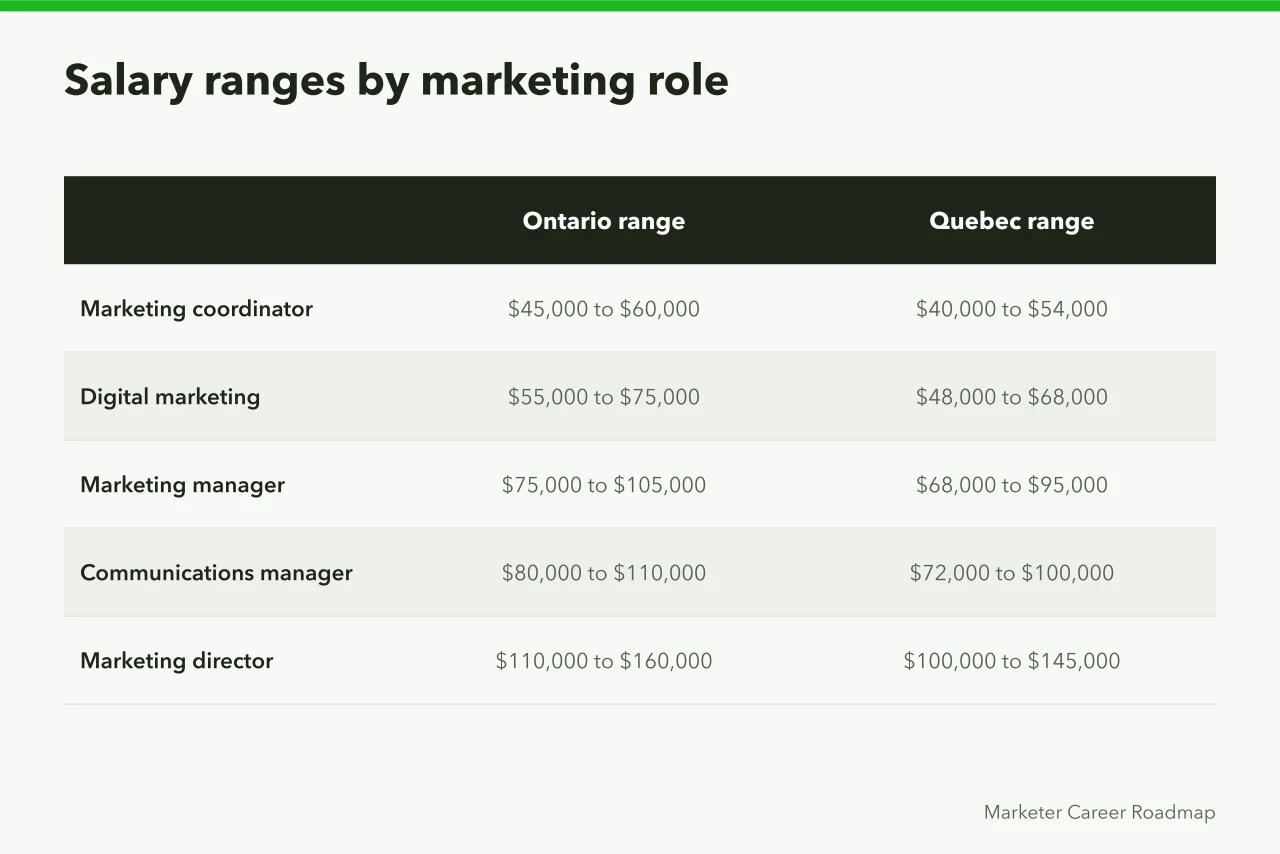
Here is a rough comparison for common marketing titles, expressed as annual base salary in Canadian dollars. Treat these as broad ranges, not offers.
Check any range against the Job Bank wage page for NOC 11202 and NOC 10022 in the province you are targeting. Each wage page states its reference period and the date it was last updated.
Salary ranges for comparable marketing roles
Ontario range
- Marketing coordinator
- $45,000 to $60,000
- Digital marketing specialist
- $55,000 to $75,000
- Marketing manager
- $75,000 to $105,000
- Communications manager
- $80,000 to $110,000
- Marketing director
- $110,000 to $160,000
Quebec range
- Marketing coordinator
- $40,000 to $54,000
- Digital marketing specialist
- $48,000 to $68,000
- Marketing manager
- $68,000 to $95,000
- Communications manager
- $72,000 to $100,000
- Marketing director
- $100,000 to $145,000
The gap narrows once you adjust for the cost of living. Montreal rents remain well below Toronto rents for comparable units, while Quebec's income tax burden is higher and childcare and tuition cost less.
A worked example: the same specialist role at $70,000 in Toronto and $62,000 in Montreal. After rent, transit and tax, the Montreal offer can leave you with more disposable income, depending on your household.
Bilingual premium is real but uneven. In Quebec, French is usually a baseline requirement rather than a bonus, so it does not always add pay. In Ontario, a genuine French-English capability can add a premium in federal, healthcare and financial services roles.
The federal bilingualism bonus for public servants in bilingual positions has long been $800 a year. A second-language profile such as BBB or CBC is what decides access to those roles.
For a wider city-by-city view of how these numbers move, see Toronto, Vancouver, and Montreal compared.
French-English requirements and how employers screen for them
French-English requirements are the single biggest practical difference between the two markets. In Quebec, employers can generally require French under the Charter of the French Language, and most marketing roles are posted as bilingual or French-first.
The Charter, amended by Bill 96 in 2022, extends francization duties to Quebec businesses with 25 or more employees and requires them to register with the Office quebecois de la langue francaise. Postings, internal documents and client work are expected to be in French first.
In practice, that means your CV, cover letter and interview may all happen in French. Employers often test written French through a short exercise, because marketing work involves copy, campaigns and client communication.
Ontario employers usually list French as an asset rather than a requirement. Exceptions include federal public service roles, some provincial government roles, healthcare communications and companies with significant Quebec or francophone client bases.
How employers screen varies. Some ask for a self-assessment. Some run a conversation in French during the interview. Some ask for a writing sample in both languages. A few use formal language testing.
What counts as bilingual differs by employer. Agency bilingual often means fluent spoken French and solid written French. Federal bilingual means meeting a defined second-language profile such as BBB or CBC, where each letter is the required level in reading, writing and oral interaction and C is the highest.
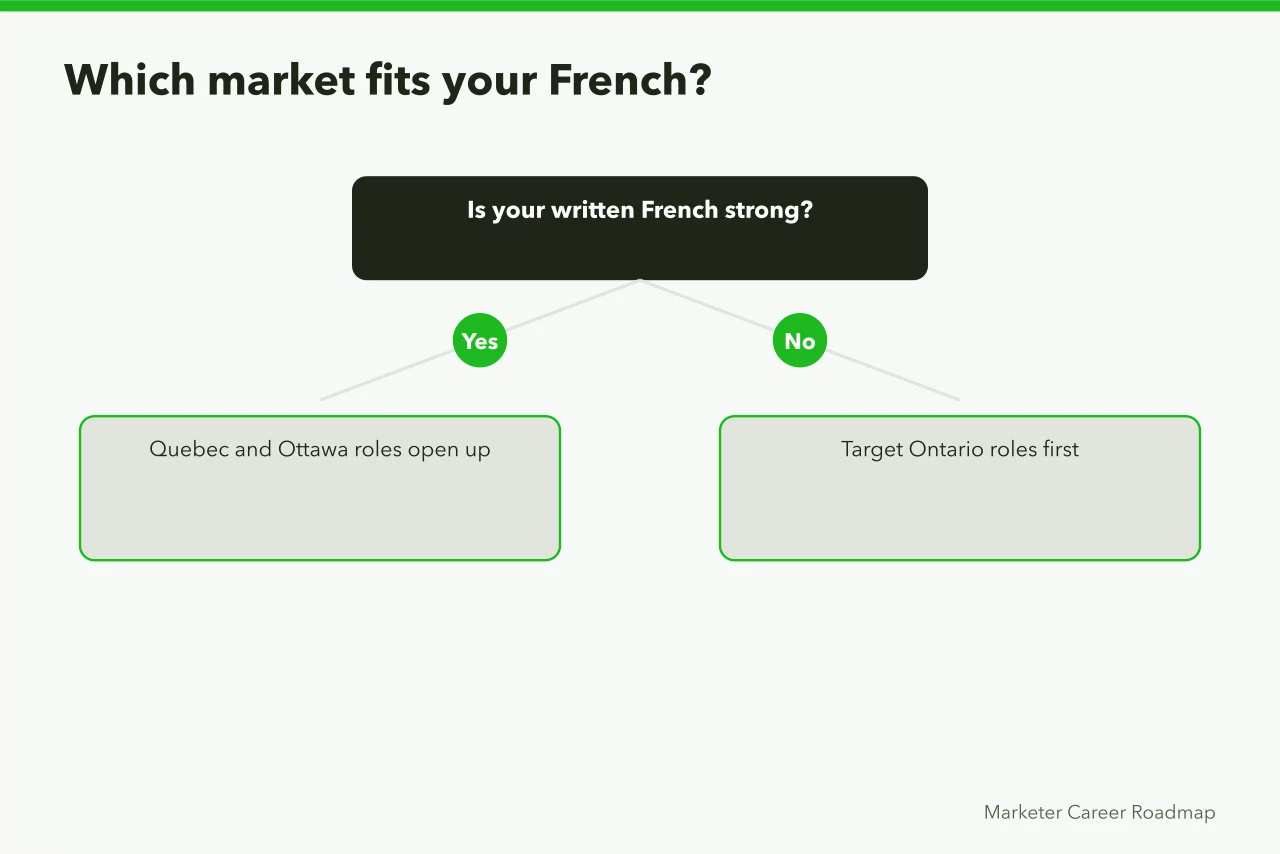
If your French is conversational but your written French is weak, target Ontario roles first and build the writing. If both are strong, Quebec and Ottawa both open up, and you clear a filter most applicants fail before your portfolio is read.
Bilingual roles in Ottawa and the National Capital Region
Ottawa and Gatineau form a single labour market split by a provincial border and a river. Federal departments, agencies and Crown corporations sit on the Ontario side. Quebec-side employers include provincial bodies and a large public administration cluster.
That geography creates steady demand for bilingual marketing and communications professionals. Federal communications roles, in particular, expect both official languages, and many are staffed through formal competitions.
Private-sector demand follows the same pattern. Agencies and consultancies in the National Capital Region serve government clients and need staff who can write and present in both languages.
Salaries in Ottawa tend to sit between Toronto and Montreal levels for comparable roles. Federal positions bring pension and benefits that private-sector roles rarely match, which changes the total compensation comparison.
The trade-off is pace and variety. Government marketing work moves slowly and follows procurement rules. Agency work in the same city moves faster but pays less at the junior end.
If bilingualism is your main asset, Ottawa is the market where it is worth the most. If it is not, Toronto, Kitchener-Waterloo and Montreal remain the larger private-sector markets.
Quebec hires from local programmes, Ontario hires portfolios
Where you study should follow where you intend to work. Quebec employers recognize Quebec college and university programmes, and many hire through local internships and stage placements. Ontario employers recruit heavily from Ontario programmes and care more about portfolio than institution.
Tuition differs sharply. Quebec residents pay among the lowest university tuition rates in Canada, and the province's employment portal, Employment | Gouvernement du Québec, lists programmes and services for job seekers. Out-of-province students pay more, which changes the return on a Quebec degree.
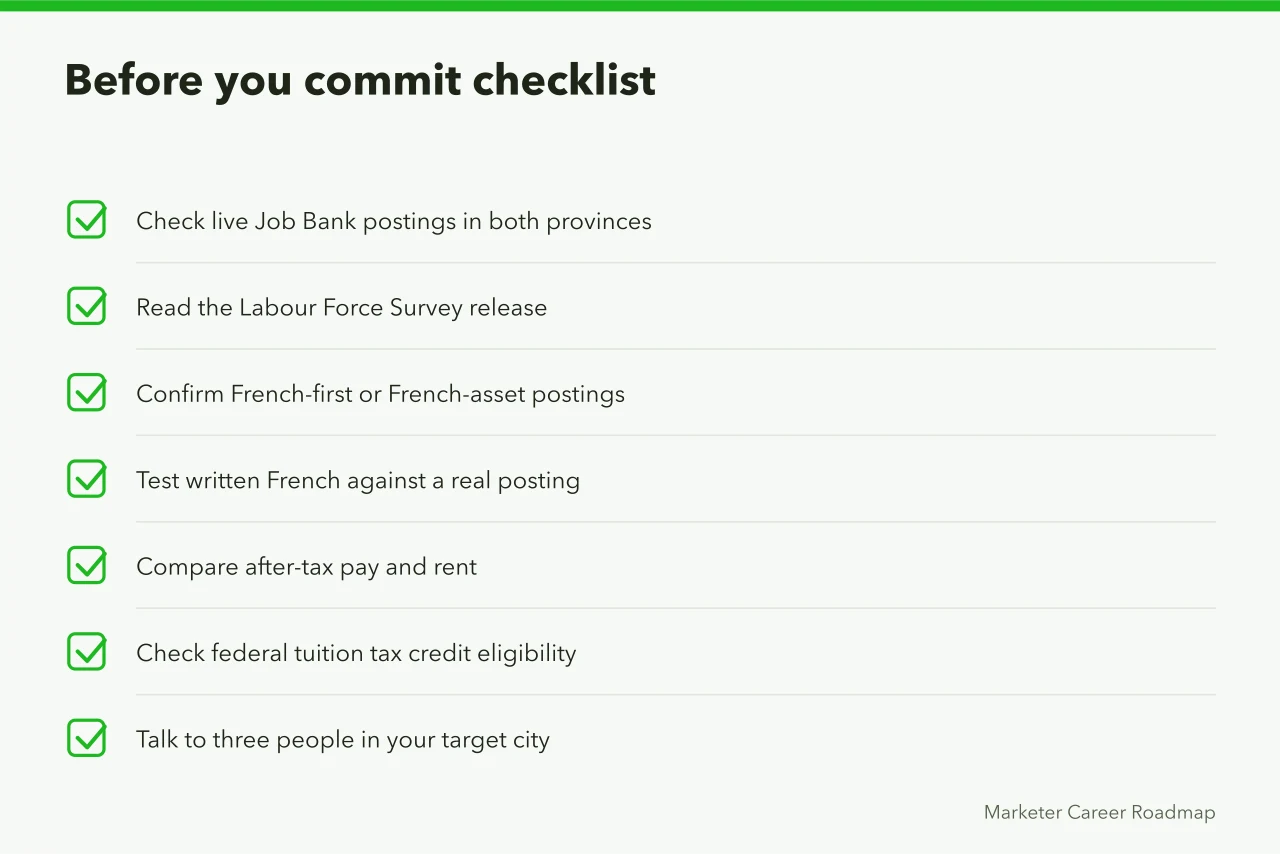
Use a simple checklist before you commit.
- Check live postings for your target title in both provinces on Job Bank.
- Read the Labour Force Survey release for the province you are considering.
- Confirm whether roles you want are posted as French-first or French-asset.
- Test your written French against a real job posting's requirements.
- Compare after-tax pay and rent, not gross salary alone.
- Check whether your programme qualifies for the federal tuition tax credit.
- Talk to three people doing the job in the city you are targeting.
Then apply in the market you can actually compete in. A strong portfolio in Ontario beats a weak bilingual application in Quebec, and the reverse is equally true.
Finally, know what you are worth before you negotiate. A clear view of the digital marketing salary bands in your target city keeps the conversation grounded in data rather than hope.