
Industry
Marketing Salary in Canada: Toronto, Vancouver, and Montreal Compared
Marketing salary in Canada varies by city more than by title. Toronto, Vancouver and Montreal differ on pay, tax, rent and hiring depth in each market.
What to take away
- Toronto and Vancouver sit in the same gross pay band for most mid-level marketing roles.
- Montreal pays less on paper, but lower rent and transit costs narrow the monthly gap.
- Quebec takes more in income tax and payroll deductions, so compare net pay rather than advertised salary.
- No city wins on every criterion. Role type and seniority decide the answer.
- Check Job Bank wage data for your occupation before you quote a figure to an employer.
Toronto and Vancouver are the markets Canadian marketers compare first. Both carry deep agency benches and large in-house teams. Their gross pay bands overlap, so the argument usually shifts to cost of living.
What is being compared
Three metropolitan markets for people who do marketing work for a living. Each sets pay through a different mix of employers.
Toronto draws national brand teams and banks, plus a dense agency sector. Vancouver runs smaller. Its accounts sit mostly in technology, retail and tourism. Montreal has agencies and game studios, and a bilingual hiring norm that changes who gets interviews.
This is not a ranking of cities. It is a question of which market leaves you more money. The gap between a paid search specialist and a brand coordinator is often wider than the gap between cities. Marketing analytics careers sets out how those bands move once you specialise.
The criteria that matter
Six criteria decide the answer. Gross pay band. Federal and provincial tax. Payroll deductions, including CPP, EI and the Quebec Pension Plan. Rent for a one-bedroom near transit. Monthly transit cost. Hiring depth in your own role.
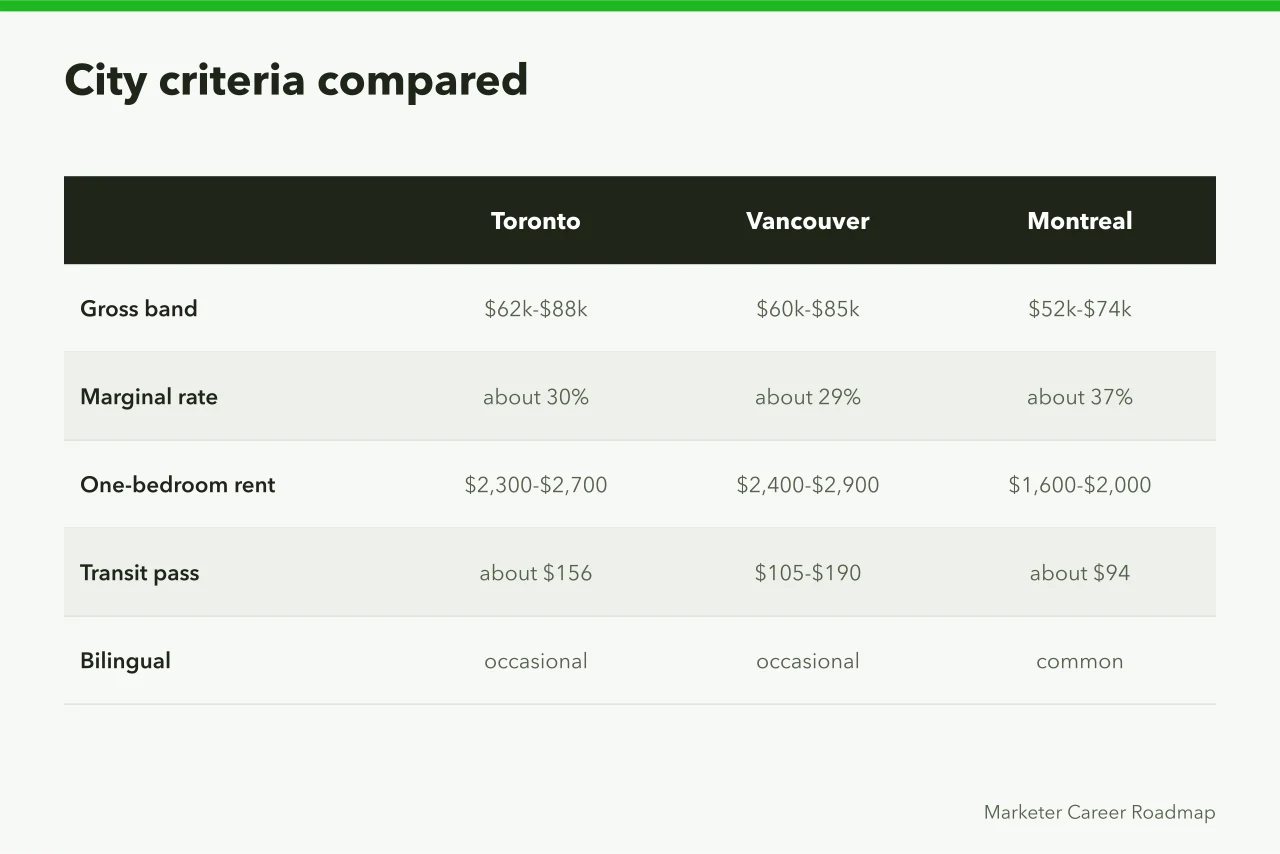
Figures below are illustrative ranges. Check Job Bank for your occupation before you rely on them. Salary bands follow published Job Bank wage data for the occupation. Rent ranges follow CMHC rental market reports. Transit fares come from the published TTC, TransLink and STM monthly passes. All figures are 2024 Canadian dollars.
Junior bands assume 0 to 2 years and no budget ownership. Senior bands assume you run a team, a budget or both. The Quebec figure of about 37% assumes a single filer with taxable income near $63,000, the middle of the Montreal band. It covers federal tax after the Quebec abatement and provincial tax.
QPP and QPIP contributions sit on top of that rate.
Toronto
- Gross band, junior, 0 to 2 years
- $48,000 to $64,000
- Gross band, mid-level specialist
- $62,000 to $88,000
- Gross band, senior or manager
- $88,000 to $125,000
- Combined marginal rate, middle of band
- about 30%
- Central one-bedroom rent
- $2,300 to $2,700
- Monthly transit pass
- about $156
- Bilingual requirement
- occasional
Vancouver
- Gross band, junior, 0 to 2 years
- $46,000 to $62,000
- Gross band, mid-level specialist
- $60,000 to $85,000
- Gross band, senior or manager
- $85,000 to $120,000
- Combined marginal rate, middle of band
- about 29%
- Central one-bedroom rent
- $2,400 to $2,900
- Monthly transit pass
- $105 to $190
- Bilingual requirement
- occasional
Montreal
- Gross band, junior, 0 to 2 years
- $40,000 to $54,000
- Gross band, mid-level specialist
- $52,000 to $74,000
- Gross band, senior or manager
- $74,000 to $105,000
- Combined marginal rate, middle of band
- about 37%
- Central one-bedroom rent
- $1,600 to $2,000
- Monthly transit pass
- about $94
- Bilingual requirement
- common
Toronto: deep market, high rent
Toronto holds the most marketing openings in Canada. That depth lets you switch employers without leaving the city, but rent runs higher.
A $75,000 gross leaves roughly $4,300 a month after tax and deductions, and a central one-bedroom can absorb half. The Job Bank wage report lists the range by province, so you can test an offer against it.
Vancouver: similar gross, thinner bench
Vancouver pays near Toronto for the same titles, but its market is smaller: fewer national brands keep head offices there, so senior seats are scarcer.
BC taxes sit slightly below Ontario's mid-band, but rent is the highest of the three. The marketing degree worth it comparison covers the cost side.
Montreal: lower gross, lower fixed costs
Montreal posts lower gross salaries for the same titles, while Quebec income tax and QPP contributions take a larger share, widening the advertised-to-net gap.
Rent is lowest of the three and the transit pass is cheapest, while French is often required for client-facing work, so unilingual candidates face a shorter list. Job Bank's occupation summary shows requirements and outlook side by side.
Example: one offer, three cities
Take a single figure and run it through each province.
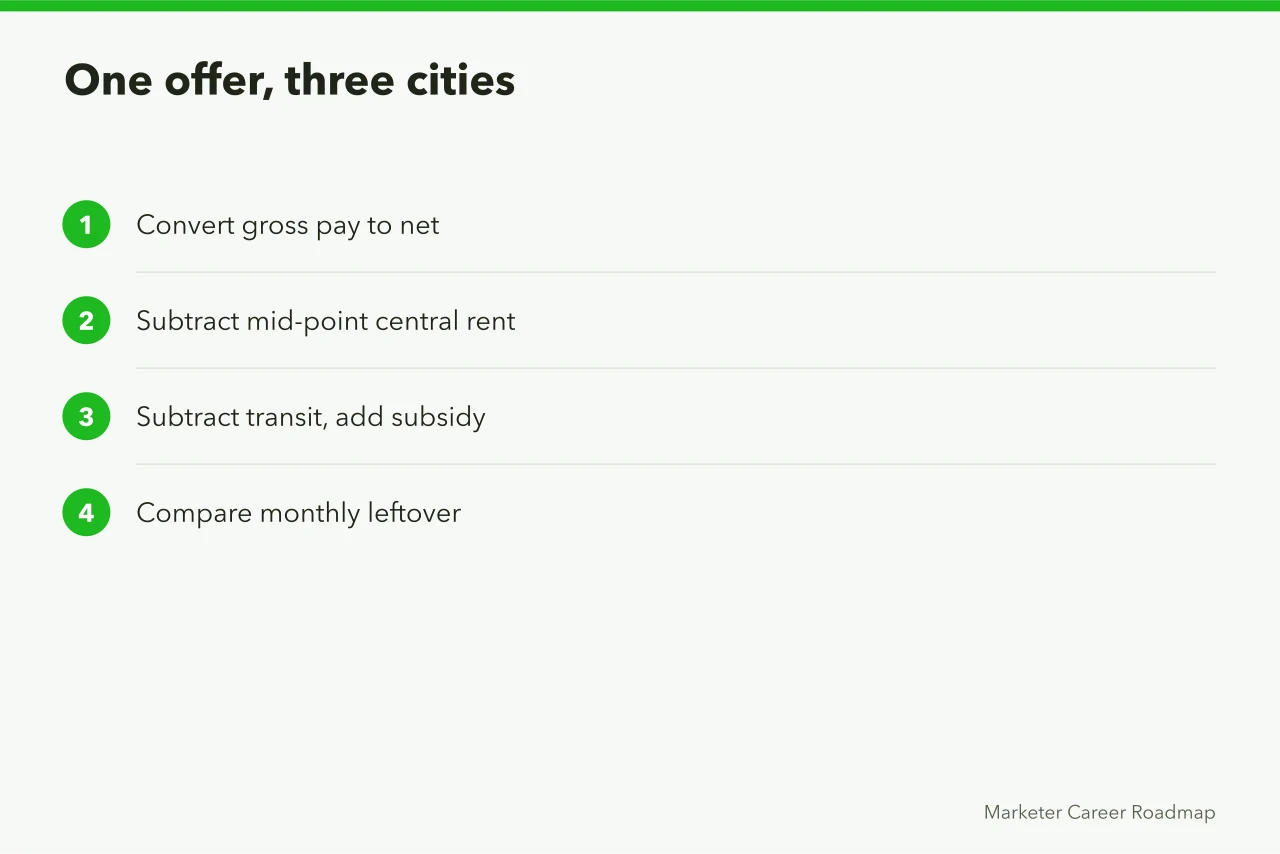
Use a $75,000 gross offer. Assume a single filer, no dependants, no RRSP deduction and only basic personal credits. The same offer sits mid-band in Toronto and near mid-band in Vancouver, and above the Montreal band, because the same title pays less there.
Ontario
- Gross pay
- $75,000
- Tax and payroll deductions
- about $23,400
- Net pay, full year
- about $51,600
- Net pay, per month
- about $4,300
British Columbia
- Gross pay
- $75,000
- Tax and payroll deductions
- about $22,500
- Net pay, full year
- about $52,500
- Net pay, per month
- about $4,375
Quebec
- Gross pay
- $75,000
- Tax and payroll deductions
- about $27,700
- Net pay, full year
- about $47,300
- Net pay, per month
- about $3,940
Montreal nets about $360 a month less than Toronto on the same gross. Central rent runs $700 to $900 a month lower in Montreal, so it covers that gap and then some. Vancouver nets the most and pays the most rent, so the two roughly cancel.
Extra credits, RRSP contributions and the number of pay periods all shift the monthly figure.
Where each one wins
Each market is the right answer for someone.
Toronto suits people who change employers every couple of years and want a short job search. Vancouver suits senior candidates who can negotiate before they move, because the local bench is thin. Montreal works for bilingual marketers who want low fixed costs and can accept a lower gross figure.
Credentials rarely override a thin market. The CMA chartered marketer question is worth settling early.
What none of them solve
All three markets share one limitation. City medians blend job titles that are not the same job. A marketing manager in Montreal may run a team of two, while the same title in Toronto may carry a national budget. No wage table corrects for that.
None of them settles tax reporting either. Employment income earned from a Canadian address belongs on a Canadian return, whoever signs the paycheque, and the CRA page on employment income sets out what has to be reported.